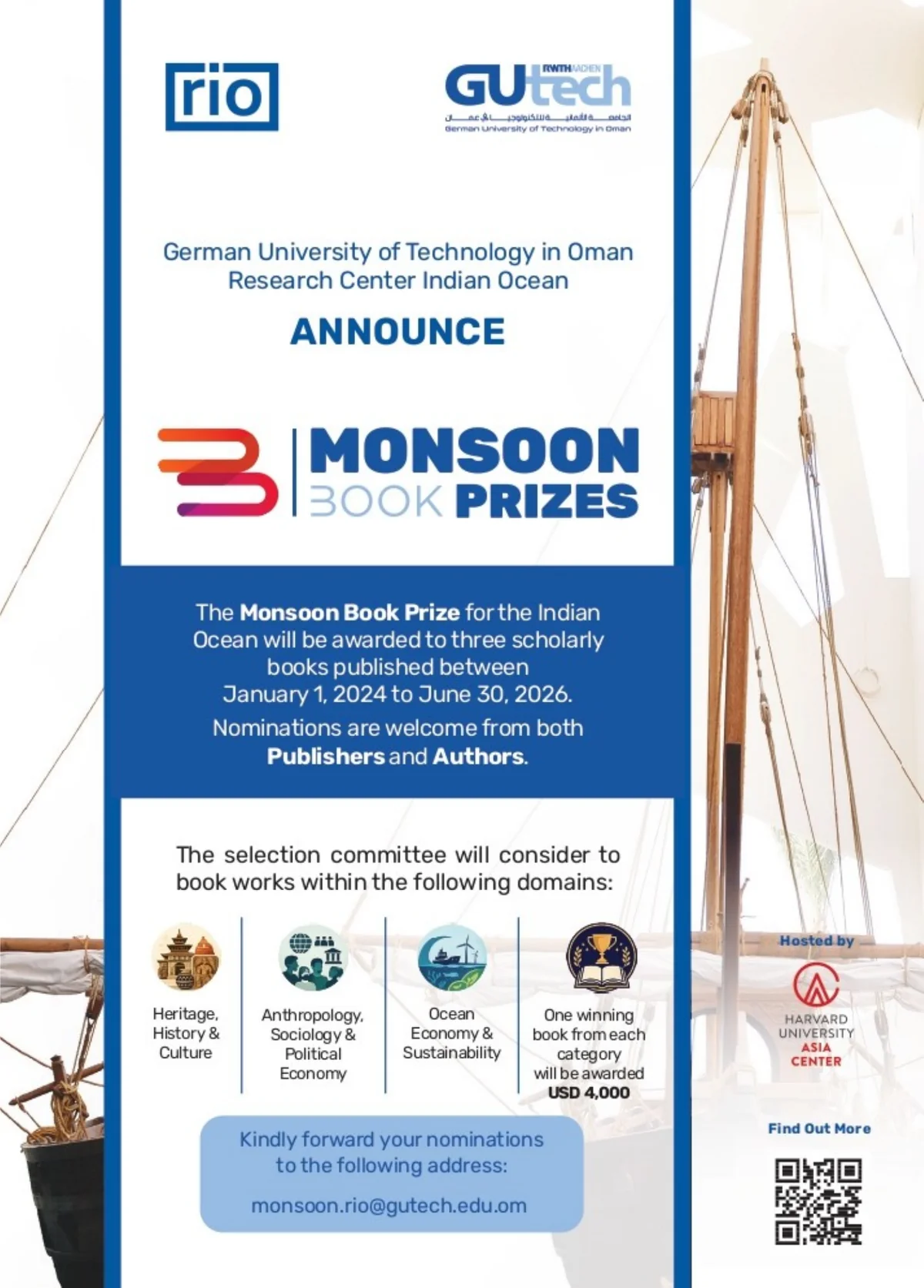
The Monsoon book Prize is established by the German University of Technology in Oman GUtech with the objective of encouraging and celebrating research, production, and publication in the field of Indian Ocean Studies globally. The role of Oman in the Indian Ocean trade and Monsoon navigation has been fundumnetal in creating a shared heritage and shaping now a booming economic region. In recognition of the importance of the oldest body of water that has facilitated trade and subsequently created a shared heritage, GUtech established the Reseach Center for the Indian Ocean (RIO) in 2018. RIO is a leading center of knowledge and pioneering international and interregional research center. The Monsoon Prize for the Indian Ocean Studies helps to catalyze the role of RIO and the Sultanate of Oman in this domain. GUtech previously collaborated with Georgia State University (GSU) and ran a pilot round of the prize in 2024 with an award ceremony held at the GSU in April 2025. For the next prize, to be awarded in 2027, GUtech plans to collaborate with Harvard University Asian Studies Center. The Monsoon Book Prize for the Indian Ocean is awarded to three scholarily books published from January 1, 2024 to June 30, 2026. The following domains has been identified:

  1. Heritage, history and culture
  2. .Anthropology, sociology and political economy
  3. Ocean economy and sustainability

The main purpose of the three proposed prizes is to encourage and celebrate the research, production, and publication of accessible, high-quality, and original scholarship, in English. A second intent of these prizes is to propel a dialogue about the Indian Ocean region and the Arabian Peninsula and to make this dynamic a core part of the academic conversation. These multidisciplinary prize documenting the region from a socio-economic, cultural and historical perspective celebrates scholarship focused on the past, present and the future. The prize also recognize the broader connections between coast, hinterland and overseas that are the foundation of the prosperity of the diverse and divergent cultures and economies of the Indian Ocean. Scholarship in the fields of social sciences, humanities and sustainability that emphasize the social as well as the economic element of Indian Ocean are especially welcome.

There are four main benefits of these proposed prizes.
First, they will benefit scholars of a field through financial support of their research. Indian Ocean studies and studies of larger interactions with the Arabian Peninsula are not recognized currently by many prizes. While book prizes as monetary awards are important for scholars, the recognition
provided by a book prize can go far beyond funding. They establish a scholar’s career. They can ensure tenure or promotion to higher ranks within academia. This makes these proposed prizes especially valuable to scholars, especially since such prizes are lacking. Currently scholars of the Indian Ocean and Arabian Peninsula compete with an overly broad pool of scholars in Middle East Studies or History more generally for a limited number of prizes such as the Hourani Award by the Middle East Studies Association. As an opportunity to publicly celebrate the awarding of prizes in the press, the prizes will increase international understanding of Oman, the Arabian Peninsula, and the Indian Ocean. Third, the prizes will benefit future generations of readers and will help to further establish, over time, the reputation of Oman as a Sultanate that encourages the preservation of history, heritage, and culture, but also the deeper understanding and interpretation of that history in a way that also makes it accessible. The “public sphere” that these prizes benefit will include not only other academics but also journalists, politicians, diplomats, businesspeople, and even regular people who might be engaged with Oman, Arabia, or the Indian Ocean. Finally, the prize ceremony will be an event that encourages conversations between prize recipients, the scholarly community and graduate student attendees, inspiring fruitful interdisciplinary dialogue.

  • Either authors or publishers are welcome to submit books.
  • Books may also be nominated by the members of the selection committee.
  • Both single authored and edited books will be welcome, although both must show a unity of theme, argument, and purpose.
  • Submissions must be made by a deadline determined by the committee. Books should be submitted in as PDFs.
  • Non-published manuscripts will not be accepted, only complete and published books or final proofs slated for publication before June 30, 2026.
  • Books must have been published from January 1, 2024 to June 30, 2026
  • Any book can only receive one prize and may not receive a new prize as a new edition.
  • Peer reviewed books by University Presses or established scholarly trade presses are welcome.
  • Books not peer-reviewed will not be considered except at the committee’s discretion.
  • All submissions should be in English, or should be complete, published English translations of academic books.
  • Both authors and publishers/editors may submit books.
  • An author may submit for only one of the prizes in any given year but may resubmit for consideration in future years.
  • An academic book publisher, working for a press, may submit an unlimited number of books in any given year with the consent of the authors. Authors should inform their press of their intent to submit for the prize and it will be up to authors to coordinate with their presses and editors the submission of books in time to the committee.
  • In addition to a full PDF, authors and/or publishers (although this is not required for publishers) may submit a brief letter, no more than 500 words, stating their name, best contact information (email and cell phone required) affiliation and background.
  • An optional author CV (no longer than 2 pages will be accepted) can also be appended to the letter.
  • No late submissions will be accepted except at the committee’s discretion in extraordinary circumstances.
  • Physical attendance at the ceremony is expected and we will coordinate with prize winners to pay for flight, accommodations and other logistics that may be required. If there are co-authors, only one author will be funded to come to the prize ceremony, unless the budget is available to invite both.
  • Co-authors will agree to split the monetary prize. 
How to submit nominations?

Submit by October 1, 2026 .
Kindly forward your nominations to the following address: monsoon.rio@gutech.edu.om

Selecting Committee

Dr. Abdulrahman Al-Salimi GU Tech:Co-Chair


Abdulrahman al-Salimi- Sultanate of Oman is a scholar of early Islamic and contemporary Islamic thought. Currently, he is focusing on editing eighth and ninth-century Ibadi texts as well as Mutazilte texts, assessing their authenticity and analyzing their contents. These sources will deepen our understanding of early Islamic political thought and theology. He is also working on Portuguese documents found in the Indian Ocean. See his publications.

Dr. Allen Fromeherz, Georgio State University: Co-Chair

Dr. Allen Fromherz is Professor of History and Director of the Middle East Studies Center at Georgia State University. He is the author of several books on the Gulf and the Indian Ocean world including The Center of The World: A Global History of the Persian Gulf from the Stone Age to the Present, University of California Press, 2024; Qatar, A Modern History (Georgetown), The Gulf in World History: Arabia at the Global Crossroads (Edinburgh) and From Muscat to Zanzibar: Sayyid Said bin Sultan’s Cosmopolitan Empire (SQCC). He edited Sultan Qaboos and Modern Oman, 1970-2020 with Dr. Abdulrahman al-Salimi and hosted the Sultan Qaboos and Modern Oman conference at GSU in 2022. Dr. Fromherz was senior humanities fellow at NYU Abu Dhabi in 2016 and received a Sultan Qaboos Cultural Center grant and a Senior Scholar Fulbright Scholarship. He has been an active member of the Ibadi Studies Seminar. In addition to scholarship on the Gulf, he is also the author of several books on North Africa Ibn Khaldun, Life and Times and The Near West (Edinburgh) and is the President of the American Institute for Maghrib Studies (AIMS).

Prof. Heba Aziz- Chaiperson: Research Indian Ocean

Professor Heba Aziz is an academic specialising in heritage, tourism, and sustainable development at the German University of Technology in Oman, where she holds the UNESCO Chair in World Heritage Management and Sustainable Tourism in the Arab Region. She directs the Research Centre in the Indian Ocean (RIO) and chairs the Monsoon Prize for Indian Ocean Studies. From 2021 to 2023, she served as Director of the Arab Regional Centre for World Heritage, a UNESCO Category II Centre in Bahrain. Over a twenty-year career in Oman, she founded bachelor’s programmes in Sustainable Tourism and Logistics, and an MBA in collaboration with the University of Vienna. She has advised the governments of Oman and Bahrain on tourism development and held academic posts at the University of Surrey, Sultan Qaboos University, and the University of Alexandria. Her research spans cultural tourism, World Heritage, heritage interpretation, and digitalisation. She holds a PhD from the University of Surrey, an MSc from the University of Strathclyde, and a BSc from the University of Alexandria.

About The Winners 2024

On behalf of the German University of Technology in Muscat, Oman, and the Monsoon Book Prizes selection comittee, we are pleased to announce the winners of the inaugural Mansoon Book Prizes.

Seema Alavi

Seema Alavi

The Monsoon Book Prize in Political Economy is awarded to Dr. Seema Alavi for her book, Muslim Cosmopolitanism in the Age of Empire (Harvard University Press)

The Monsoon Prize in Political Economy- Dr. Seema Alavi

Seema Alavi is a historian who specializes in early modern and modern South Asia, with an interest in the transformation of the region’s legacy from
Indo-Persian to one heavily affected by British colonial rule. She started her teaching career at the Jawaharlal Nehru University New Delhi; and has
been a Professor at Delhi University, Delhi before moving to Ashoka University in 2022.
Alavi earned her PhD from Cambridge University, England. She has twice been a Fulbright Scholar and a Smuts Visiting Fellow at Cambridge and was a
visiting scholar at the Harvard-Yenching Institute, Harvard. In 2010 she was at the Radcliffe institute at Harvard as the William Bentinck-Smith Fellow.
She has written books on the military, medical and religious histories of India. Her most recent book is Sovereigns of the Sea. Omani Ambition in the
age of Empire, Penguin India, 2023.
She wrote Sepoys and the Company: Tradition and Transition in Northern India, 1770–1830 (Oxford University Press, 1995) and co-authored with
Muzzafar Alam, A European Experience of the Mughal Orient: The I‘jaz-i Arsalani (Persian Letters 1773–1779) of Antoine-Louis Henri Polier (Oxford
University Press, 2001). Her book Eighteenth Century in Indian History in the Oxford Debates series is a popular reader in India and abroad. In 2009
she wrote Islam and Healing : Loss and Recovery of an Indo-Muslim Medical Tradition,
1600–1900 (Palgrave Macmillan, UK 2009). She serves on the editorial board of several national and international journals, including Modern Asian
Studies UK, Journal of Colonialism and Colonial History, UK, Journal of the Royal Asiatic Society, UK and Biblio, New Delhi.

Jatin Dua

Jatin Dua

Honorable Mention in Political Economy – Dr. Jatin Dua, Captured at Sea: Piracy and Protection in the Indian Ocean (University of California Press)

Honorable Mention in Political Economy- Dr. Jatin Dua

Jatin Dua is an associate professor of Anthropology and Director of the Oceans Lab at the University of Michigan, a research and teaching initiative dedicated to collaborative and multimodal ways of engaging oceans. His research explores maritime mobility, and its perils and possibilities, focusing on processes and projects of governance, law, and economy. His book, Captured at Sea: Piracy and Protection in the Indian Ocean, published with the University of California Press (December 2019) and winner of the 2020 Elliot P. Skinner Book Award, is a multi-sited ethnographic and archival engagement with Somali piracy and contestations over legitimate and illegitimate commerce in the Western Indian Ocean. In addition, he has published a number of articles on maritime anthropology, captivity, political economy, and sovereignty in Africa and beyond. He is the chief editor of the journal Comparative Studies in Society and History.

Nathaniel Mathews

Nathaniel Mathews

The Monsoon Book Prize in History is awarded to Dr. Nathaniel Mathews for his book, Zanzibar Was a Country: Exile
and Citizenship between East Africa and the Gulf (University of California Press)

Monsoon Book Prize in History Dr. Nathaniel Mathews

The Monsoon Book Prize in History is awarded to Dr. Nathaniel Mathews for his book, Zanzibar Was a Country: Exile and Citizenship between East Africa and the Gulf (University of California Press) Nathaniel Mathews is an Associate Professor in the Department of Africana Studies at SUNY Binghamton. He has a B.A. in History from Howard University and an M.A. in Global, International, and Comparative History from Georgetown University. In 2016, he completed a dissertation in Northwestern University’s history department on the Zanzibari community in Oman, and in 2024 published Zanzibar Was a Country, his first book. He has also published on the topic of slavery and abolition in Islam. He is currently working on a second project about transregional migration to Zanzibar in the colonial period, using naturalization records from The Zanzibar Archives.

Michael Laffan

Michael Laffan

(Honorable Mention in History – Dr. Michael Laffan, Under Empire: Muslim Lives and Loyalties Across the Indian
Ocean World, 1885-1945 (Columbia University Press

Michael Laffan (Honorable Mention in History Dr. Michael Laffan

Michael Laffan obtained his B.A. in Asian Studies (Arabic) from the Australian National University in Canberra (1995) and his Ph.D. in Southeast Asian History from the University of Sydney (2001). He has been at Princeton’s history department since 2005. His first book, Islamic Nationhood and Colonial Indonesia: The Umma Below the Winds (Routledge, 2003), argued that Islam played an important role in the Indonesian nationalist movement. He followed this with The Makings of Indonesian Islam (Princeton, 2011), which looks at the results of an engagement between Islamic reformers with intellectual links to Cairo and influential colonial scholars. His newest book, Under Empire (Columbia, 2022), looks at two centuries of interactions between Muslim subjects of empires and nation states across the Indian Ocean. He is currently working on a broad history of the Cocos Islands, now part of Australia.

Jim Syke & Julia Byle

Jim Syke & Julia Byle

The Monsoon Book Prize in Anthropology is awarded to Drs. Jim Sykes and Julia Byl for their edited volume Sounding the Indian Ocean: Musical Circulations in the Afro-Asiatic Seascape (University of California Press)

Monsoon Book Prize in Anthropology Drs. Jim Sykes & Julia

Jim Sykes is Associate Professor of Music at the University of Pennsylvania. A drummer and anthropologist, he holds a Ph.D. in ethnomusicology from the University of Chicago and has also taught at Yale and King’s College London. His first book, The Musical Gift: Sonic Generosity in Post War Sri Lanka, won the Bruno Nettl Prize from the Society for Ethnomusicology in 2019. With Gavin Steingo, he co-edited Remapping Sound Studies (Duke, 2019). Sykes is currently at work on two book projects. The first is a study of music, religion, media, and urban development in Singapore, focusing on Tamil Hindu drummers. The second is a comparative anthropology of musical labor that explores the historical emergence of the idea that music is ‘not a real job’. This second project centers fieldwork conducted with climate protest drummers in Berlin, Germany, in 2022-2023. The volume that won the Monsoon Prize, Sounding the Indian Ocean, was based on a symposium held at UPenn in spring 2019. Sykes would like to thank Penn’s University Research Fund for making the project possible.

Michael Lambek

Michael Lambek

(Honorable Mention in Anthropology – Dr. Michael Lambek, Island in the Stream: An Ethnographic History of Mayotte (University of Toronto Press)

Honorable Mention in Anthropology Dr. Michael LambeK

Michael Lambek (BA McGill, MA, PhD Michigan) is professor & Canada Research Chair emeritus, Department of Anthropology, University of Toronto where he taught since 1978, with intervals at the London School of Economics. He was elected Fellow of the Royal Society of Canada in 2000. Lambek has carried out extensive ethnographic research in the western Indian Ocean (Mayotte and
northwest Madagascar) and in Switzerland. He has published eight books plus one co-authored, eight edited books, and over 125 book chapters and refereed journal articles, primarily on topics of
religion, historicity, personhood, and ethical life. Knowledge and Practice in Mayotte was shortlisted for the Herskovits and Innis book awards; The Weight of the Past received honorable mention for the Victor Turner Prize; and Island in the Stream won the Elliott P. Skinner Award. His latest book (2025) is Cohabiting with Spirits: The Biography of a Marriage in Mayotte. Lambek edits book series at the University of Toronto Press and at Cambridge University Press. He has supervised 21 doctoral students to completion.

Contact

GUtech, PO Box 1816, Athaibah PC 130 Muscat, Sultanate of Oman. Halban, next to Southern Expressway, Muscat

Tel: (968)22061330 | (968) 22061111